Deconstructing Cheque Bounce Law: 5 Landmark Judgments Defining Section 138
13 Jul 2026 · 5 min · Legal Team
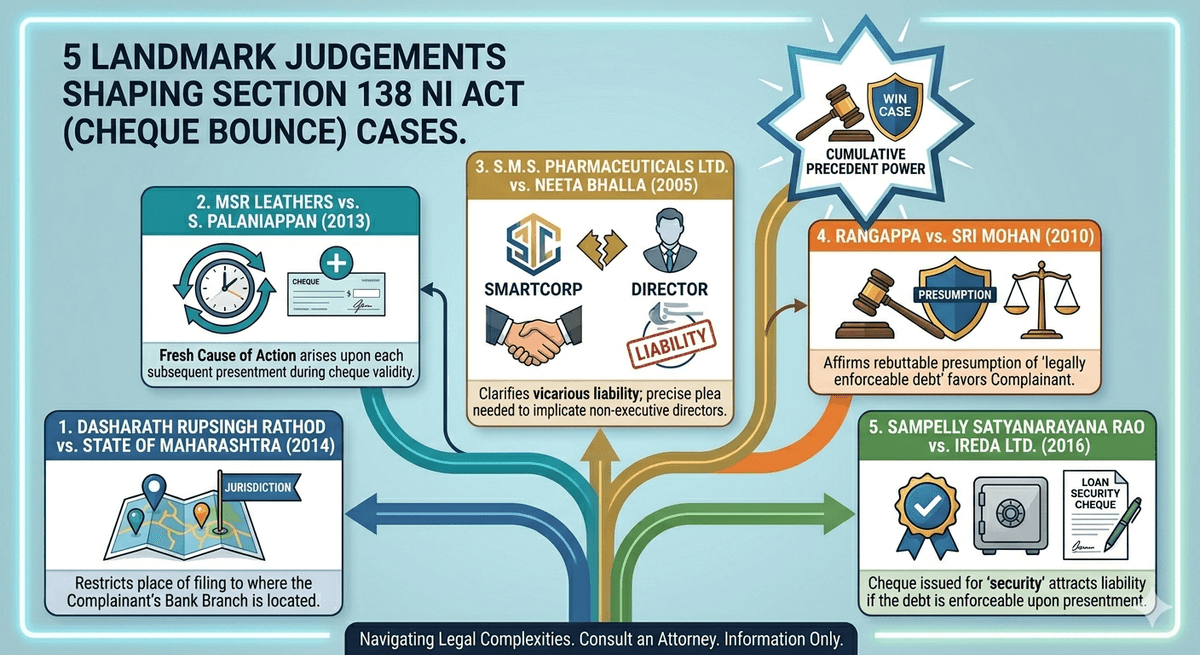
Section 138 of the Negotiable Instruments Act, 1881, is one of the most frequently invoked provisions in Indian courts. While the statute lays the groundwork for prosecuting cheque dishonor as a criminal offense, it is the judiciary that has shaped its practical application. Over decades, the Supreme Court of India has delivered several landmark judgments that have clarified complexities, resolved contradictions between different courts, and established concrete rules that apply today.
For any legal professional, business owner, or individual involved in a Section 138 case, understanding these specific precedents is not optional—it is essential for building a strategy.
Why Landmark Precedents Matter in NI Act Cases
The Negotiable Instruments Act is a complex piece of legislation. It aims to ensure credibility in business transactions by making cheque bounce a punishable offense. However, real-world scenarios—such as delayed notices, cheques issued for security, or jurisdictional disputes—often fall into gray areas.
Landmark judgments act as a binding guide (Stare Decisis) for lower courts. They provide the definitive interpretation of the law, making legal outcomes more predictable and ensuring uniformity across the country.
Here are five seminal judgments that have fundamentally altered the landscape of Section 138 litigation.
1. The Question of Jurisdiction: Dashrath Rupsingh Rathod vs. State of Maharashtra (2014)
Perhaps the most significant procedural shift in Section 138 history occurred with the Dashrath Rupsingh Rathod judgment.
The Precedent: Before this ruling, complainants often filed cases in jurisdictions that were convenient for them, sometimes far from where the accused resided, leading to significant harassment. The Supreme Court established a strict rule: the territorial jurisdiction for filing a Section 138 complaint lies only where the cheque is presented for payment (the complainant’s bank branch).
Impact: This judgment stopped "forum shopping" and brought uniformity. Although the Negotiable Instruments (Amendment) Act, 2015 later refined this rule slightly (affirming jurisdiction where the payee delivers the cheque for collection), the Dashrath Rathod decision remains the foundational precedent that defined the primary location for initiating a case.
2. The Finality of the 15-Day Notice: MSR Leathers vs. S. Palaniappan (2013)
Section 138 requires a payee to send a statutory notice within 30 days of the cheque bounce, giving the drawer 15 days to pay. If payment isn't made, the "cause of action" arises. But what if the cheque is presented again and bounces again?
The Precedent: In MSR Leathers, the Supreme Court overthrew an earlier precedent. It ruled that a payee can present a cheque multiple times within its validity period. A fresh cause of action arises each time the cheque bounces and a new statutory notice is sent.
Impact: This gave creditors a vital strategic tool. If they missed the deadline to file a complaint after the first notice, they could present the cheque again, send a fresh notice, and restart the clock, provided the cheque was still valid.
3. Vicarious Liability and Non-Executive Directors: S.M.S. Pharmaceuticals Ltd. vs. Neeta Bhalla (2005)
When a company issues a bounced cheque, Section 141 of the NI Act extends criminal liability to every person who was "in charge of, and was responsible to, the company for the conduct of the business."
The Precedent: In S.M.S. Pharmaceuticals, the Court clarified the extent of this "vicarious liability." Crucially, it ruled that not every director is automatically liable. A specific plea must be made in the complaint describing how a particular director was responsible for the company’s day-to-day operations and the specific transaction.
Impact: This ruling protected non-executive directors and sleeping partners from malicious prosecution, forcing complainants to prove specific active roles in the business before criminal liability could be attached.
4. The Presumption of Enforceable Debt: Rangappa vs. Sri Mohan (2010)
Section 139 of the NI Act includes a strong presumption that the holder of a cheque received it "for the discharge, in whole or in part, of any debt or other liability."
The Precedent: The Rangappa judgment firmly established that this presumption is mandatory, not discretionary. However, it also clarified that this is a rebuttable presumption. The accused does not need to prove their innocence beyond a reasonable doubt; they only need to raise a "probable defense" that shifts the burden back to the complainant.
Impact: This balanced the playing field. It ensured that complainants don't have to initially prove the underlying debt exists, speeding up trials, while still allowing the accused a fair chance to disprove the liability with strong, probable evidence.
5. Cheques Issued as 'Security': Sampelly Satyanarayana Rao vs. Indian Renewable Energy Development Agency Ltd. (2016)
A very common defense in Section 138 cases is that the bounced cheque was only given as "security" for a loan, not as immediate payment.
The Precedent: In Sampelly Satyanarayana Rao, the Court ruled that if a cheque is issued as security and the debt has already become dynamic and enforceable at the time the cheque is presented, the "security" argument is invalid. If the loan amount is due and payable, a post-dated "security cheque" still triggers Section 138 liability if it bounces.
Impact: This judgment significantly strengthened commercial transactions. It closed a major loophole often used to evade liability, confirming that a "security cheque" becomes an "enforceable debt payment" the moment the underlying loan default occurs.
Overview
Understanding your legal rights is the first step toward resolution. This guide is structured for readability, SEO performance, and long session engagement.
Legal Framework
Indian law provides specific remedies and procedures. Consult a verified lawyer for case-specific advice.
FAQ
When should I consult a lawyer? Early consultation often improves outcomes significantly.