Legal Knowledge Center
SEO-optimized long-form content for authority & organic growth

Startup Funding: Legal Checklist for Founders
From incorporation to term sheets — essential steps before raising capital.
Divorce by Mutual Consent: Complete Guide 2026
Everything you need to know about filing mutual consent divorce in India.

Understanding GST Notice: How to Respond
Types of notices, deadlines, and drafting an effective legal response.
Received a Section 138 Notice? A Step-by-Step Guide to Protecting Your Legal Rights
Receiving a legal notice under Section 138 of the Negotiable Instruments Act, 1881, can be a source of significant stress. This provision deals specifically with the dishonor of cheques due to insufficient funds or other technical discrepancies.
If you have received such a notice, it is crucial to remain calm and act strategically. Ignoring the notice will not make the problem disappear; in fact, it can lead to severe legal consequences, including criminal prosecution.
Here is a comprehensive guide on how to handle a Section 138 notice effectively.
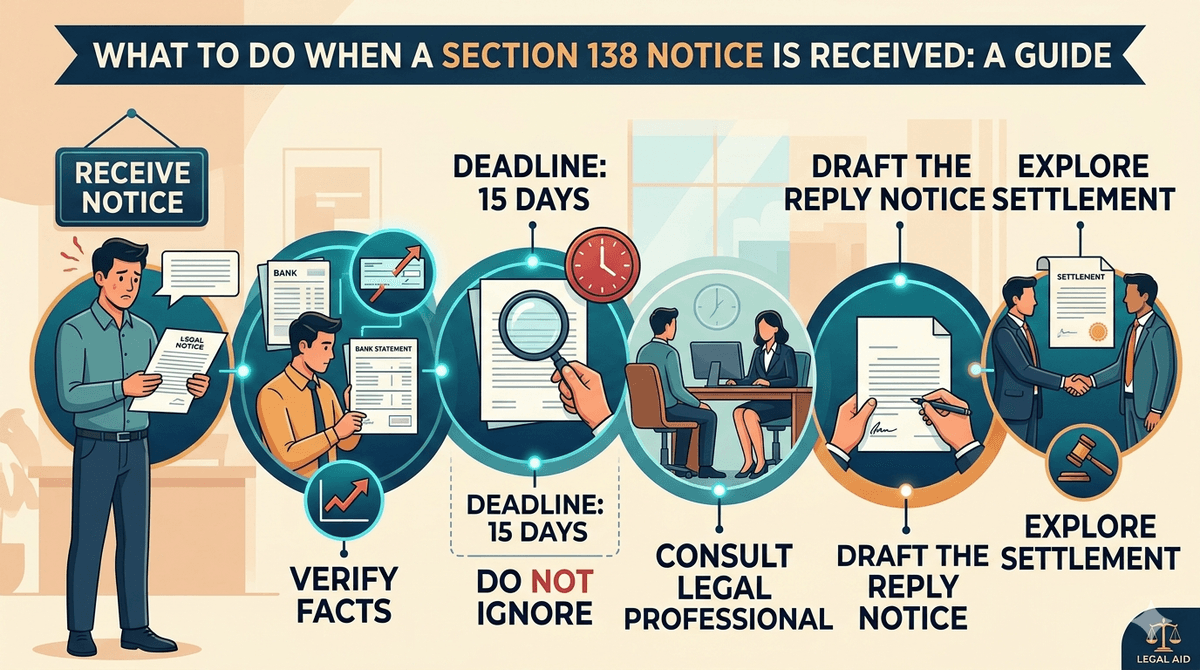
1. Do Not Ignore the Notice
The most common mistake individuals make is discarding or ignoring the legal notice. Under the law, the sender of the notice is required to provide you with 15 days from the date of receipt to make the payment.
If you fail to respond or pay within this window, the complainant gains the legal right to file a criminal complaint against you in a Magistrate's court.
2. Verify the Facts Immediately
Before taking any action, conduct a thorough internal review of the allegations:
● Check the Cheque Details: Verify the cheque number, the amount mentioned, and the date.
● Consult Your Bank: Contact your bank to confirm the specific reason for the dishonor. Was it truly "Insufficient Funds," or was it a technical error like "Signature Mismatch" or "Account Closed"?
● Assess the Debt: Determine if the debt is legally enforceable. A cheque issued for an illegal activity or a time-barred debt may have different legal standing.
3. Consult a Legal Professional
A Section 138 notice is a precursor to criminal litigation. Consulting an experienced criminal lawyer is non-negotiable. A lawyer will help you:
● Identify flaws in the notice (such as procedural delays or incorrect dates).
● Draft a formal reply that protects your rights without admitting liability inadvertently.
● Negotiate a settlement with the complainant if the debt is legitimate.
4. Drafting the Reply Notice
Even if you do not pay the amount immediately, you should generally send a formal reply notice within the 15-day timeframe. Your response should:
● State your version of the facts: Explain why the cheque was dishonored or why you dispute the debt.
● Address technicalities: If the notice itself is defective (e.g., sent beyond the statutory limitation period), your lawyer will highlight this.
● Avoid self-incrimination: Be careful with the language used to ensure you do not inadvertently admit to a liability that you do not owe.
5. Explore Settlement Options
Section 138 is a "compoundable" offense, meaning the law encourages the parties to settle the matter outside of court.
● Negotiation: If the debt is genuine, it is often cheaper and faster to negotiate a repayment plan or a "full and final" settlement rather than facing a long-drawn-out criminal trial.
● Mediation: Many courts offer mediation services to resolve such disputes amicably.
6. Prepare for Court Proceedings
If a settlement is not reached, the complainant may file a complaint. At this stage, ensure you are prepared for:
● Summons: You will receive a summons from the court. Do not skip court dates, as this can lead to the issuance of a bailable or non-bailable warrant.
● Bail: In most Section 138 cases, the offense is bailable. Your lawyer will help you secure bail once you appear before the magistrate.
Key Takeaways for Quick Action
Step | Action |
Receipt | Note the date of receipt accurately (this starts your 15-day clock). |
Review | Check your bank statements and the original transaction details. |
Legal Counsel | Contact a lawyer immediately to draft your response. |
Deadline | Do not exceed the 15-day window to send a response or make payment. |
Would you like to know more about the specific legal defenses typically used in Section 138 cases?
Logistics and Court Infrastructure of Divorce Laws in India: Jurisdictions, Mediation, and Representation
When discussing the legalities of marriage dissolution in India, substantive grounds, financial alimony, and child custody frequently take center stage. However, the operational machinery—the infrastructure, geographical boundaries, and procedural logistics—directly dictates how smoothly a case proceeds.
Navigating the family court infrastructure requires a solid grasp of its technical logistics: identifying the correct geographic forum, undergoing institutional mediation, and selecting the right legal advocate.
1. Family Court Jurisdictions: Demystifying Where to File
The foremost hurdle in launching matrimonial litigation is identifying the correct legal forum. Under Indian law (primarily governed by Section 19 of the Hindu Marriage Act, 1955 and Section 7 of the Family Courts Act, 1984), a petitioner cannot simply file a case in any convenient city. The geographical boundaries—known as territorial jurisdiction—are strictly regulated based on spatial focal points linked to the history of the marriage.
A divorce petition can legally be instituted in a Family Court situated within the local limits of where:
● The Place of Solemnization: The location where the marriage ceremony or registration originally took place.
● The Place of Joint Residence: The specific city or district where the couple last cohabited and lived together as husband and wife.
● The Respondent’s Current Residence: The location where the defending party (the respondent) is actively living at the time the petition is filed.
● The Petitioner’s Safe Haven: In a crucial protective measure under Indian law, a wife is additionally empowered to file the case in the jurisdiction where she currently resides at the time of filing, minimizing her travel burdens.
In states like Kerala, this operational workflow channels cases into specific, heavily managed institutions depending on district boundaries. For instance, urban and regional centers handle varying volumes of caseloads across hubs like Family Court Ernakulam, Family Court Trivandrum, or Family Court Kozhikode. Filing in the wrong venue risks having the petition returned, causing months of administrative delays.
2. Mandatory Counselling & Mediation: The Alternative Dispute Infrastructure
Unlike standard civil or criminal suits, Indian Family Courts operate under a statutory mandate to preserve the structural institution of marriage wherever possible. Section 9 of the Family Courts Act mandates that courts must make a concerted effort to facilitate a settlement or reconciliation. This has institutionalized an extensive pre-trial infrastructure consisting of court-appointed counselors and trained mediators.
In practice, particularly across Kerala Family Courts, the procedural blueprint unfolds in structured stages:
The Mediation & Counselling Lifecycle
The Mandatory Referral: Immediately after the respondent answers the initial court summons, the family judge halts active trial litigation and refers both parties to a court-appointed counselor. Attendance is compulsory for both spouses.
Counselling Sessions: A neutral, trained professional evaluates the nature of the marital discord. They attempt to resolve minor misunderstandings, assess if reconciliation is viable, and determine if the marriage has suffered an irretrievable breakdown.
Transition to Mediation: If mutual living is deemed completely impossible, the case transitions to formal mediation. Here, the focus shifts from saving the marriage to creating a structured, non-adversarial settlement blueprint covering alimony, asset division, and child custody.
The Outcome Report: If mediation succeeds, a formal settlement deed is signed and converted into a binding court order. If it fails, the counselor submits a "non-settlement report" back to the family judge, returning the case to the active litigation trial track.
Strategic Value: Utilizing this mediation infrastructure effectively enables couples to convert what would have been a bitter, multi-year contested battle into a clean, mutual consent divorce pathway.
3. Finding Representation: Navigating Legal Counsel Infrastructure
Because family courts deal with highly emotional, deeply personal matters alongside complex asset and property structures, securing the right legal partner is paramount. The legal ecosystem is generally bifurcated into localized trial advocates and high-court appellate attorneys.
When searching for professional advocates, individuals generally focus on two tiers of representation:
● District-Specific Civil Attorneys: These trial lawyers handle the daily grind of the local Family Courts (such as those in Ernakulam, Kozhikode, or Trivandrum). They are responsible for collecting physical evidence, drafting initial pleadings, guiding clients through court-ordered counselling, and conducting cross-examinations.
● Top Family Court Lawyers in Kerala High Court: High Court representation becomes critical if a party needs to challenge an unfavorable interim order, appeal a final divorce decree, or file transfer petitions to move a case from one district court to another. The High Court infrastructure deals strictly with constitutional validity, legal interpretation, and appellate reviews.
Prospective litigants should look for counsel possessing a proven track record in alternative dispute resolution (ADR) rather than pure litigation. An attorney skilled at negotiating settlement agreements during mandatory mediation sessions is frequently far more valuable—and cost-effective—than one who prioritizes prolonged courtroom warfare.
4. Conclusion
The logistics and court infrastructure of divorce laws in India are intentionally designed to slow down hasty separations while providing robust structured support for genuine marital collapses. By meticulously verifying territorial jurisdictions across hubs like Ernakulam or Trivandrum, actively cooperating with the mandatory mediation frameworks, and partnering with experienced matrimonial attorneys, litigants can systematically minimize the time, cost, and emotional weight of legal separation.

Alimony, Maintenance, and Asset Division in Indian Divorce Law
The financial ramifications of matrimonial dissolution represent one of the most heavily litigated areas within the Indian family court infrastructure. In India, securing financial stability post-divorce involves a complex interplay of personal religious laws, gender-centric statutory provisions, and evolving landmark judicial precedents. This guide demystifies the structural layout of alimony, maintenance, and asset division in Indian divorce laws, helping individuals protect their economic interests during legal transitions.
1. Differentiating Between Maintenance and Alimony
While often used interchangeably in casual discourse, Indian jurisprudence draws a distinct line between interim relief and long-term financial settlement:
● Interim Maintenance (Pendente Lite): Awarded under statutes like Section 24 of the Hindu Marriage Act, 1955 (HMA), this covers the dependent spouse’s basic living expenses and legal costs while the divorce proceedings are actively pending in court. It ensures that financial disparity does not handicap a party's ability to seek justice.
● Permanent Alimony: Paid upon the final dissolution of marriage under Section 25 of the HMA. This can be structured either as a one-time lump-sum settlement or as periodic monthly/quarterly payments extending into the future.
2. How Indian Courts Calculate Alimony and Maintenance
Unlike some Western legal frameworks, India does not enforce a rigid mathematical formula or digital software calculator for alimony. Instead, the Supreme Court of India, through its landmark ruling in Rajnesh v. Neha (2020), mandated that both parties must submit a comprehensive, notarized "Affidavit of Assets and Liabilities." This standardizes the review process based on several core factors:
Key Assessment Factors in Family Courts
Financial Capability and Status: The actual net disposable income, high-value financial assets, commercial investments, and outstanding liabilities of both spouses.
Standard of Living: The level of comfort, lifestyle, and social standing that the dependent spouse enjoyed while residing in the joint matrimonial home.
Earning Capacity vs. Actual Income: The educational background, professional qualifications, and employment history of the non-earning spouse. Courts assess if a spouse is intentionally underemployed.
Dependents and Age: The age and medical health conditions of the parties, alongside the financial responsibility of raising and educating minor children.
Judicial Benchmarks: While flexible, the Supreme Court has historically viewed 25% of the husband's net monthly salary as a reasonable benchmark for interim maintenance. For lump-sum permanent alimony payouts, courts often lean toward a settlement ranging between one-third to one-fifth of the paying spouse's net worth.
3. Asset Division and the Recovery of "Streedhan"
Property division following a divorce in India does not automatically trigger an equal 50/50 split of all accumulated assets. The legal title depends heavily on ownership documentation and the precise nature of the property:
The Absolute Right to Streedhan
Under Section 14 of the Hindu Succession Act, 1956, Streedhan refers to all gifts, cash, property, and gold ornaments presented to a woman before, during, or after her marriage (including wedding gifts from her own family, her in-laws, and relatives).
● The husband and his family act merely as custodians or trustees of this property.
● Upon separation, a woman retains absolute ownership. Failure to return Streedhan upon demand constitutes a criminal breach of trust under Section 406 of the Indian Penal Code (IPC) / Bharatiya Nyaya Sanhita (BNS).
Jointly Held Properties vs. Separate Assets
● Self-Acquired Property: If an asset or piece of real estate is registered solely in the name of one spouse, who independently funded the purchase, it remains their separate property after divorce. The other spouse cannot claim equity.
● Jointly Purchased Assets: If a house or investment portfolio is held jointly, the division is typically determined by each party's proven financial contribution toward the purchase, unless documented otherwise via a legal contract.
The Right to the Matrimonial Home
Under the Protection of Women from Domestic Violence Act, 2005, an estranged wife possesses an absolute right to reside in the shared matrimonial home, regardless of whether she holds a legal ownership title or financial equity in the property. The court can pass residence orders preventing her eviction, or order the husband to provide alternative, equivalent accommodation.
4. Statutory Frameworks Across Communities
Depending on the legislation under which the marriage is dissolved, maintenance rights vary slightly:
● Section 125 of the Code of Criminal Procedure (CrPC) / BNSS: A universally applicable, fast-track, gender-neutral statutory remedy enabling wives, minor children, and dependent parents to claim maintenance to prevent destitution, independent of personal religious laws.
● The Special Marriage Act, 1954: Extends maintenance provisions strictly to civil, inter-community, or registered love marriages, empowering the court to secure assets for the dependent wife.
● Muslim Women (Protection of Rights on Divorce) Act, 1986: Governs maintenance provisions for Muslim women, emphasizing reasonable and fair provisions within the Iddat period and the final settlement of Mahr (dower).
5. Conclusion
Financial litigation in an Indian divorce can span anywhere from 1 to 3 years just for the final determination of permanent alimony. To maximize success and minimize structural delays, individuals should maintain transparent financial books, trace the inheritance of jewelry via proper cataloging, and utilize mutual consent paths wherever possible. Resolving financial elements via an explicit, court-approved settlement deed remains the cleanest strategy to secure absolute economic independence post-divorce.

Legal Procedures and Timelines of Divorce in India: A Definitive Guide
Navigating the legal intricacies of the dissolution of marriage in India requires a precise understanding of personal laws, court protocols, and operational statutory timelines. Because India does not have a uniform civil code governing matrimonial disputes, procedures are dictated by the religious or civil legislation under which the marriage was originally solemnized.
Understanding the distinct pathways—mutual consent versus contested litigation—is critical for anyone seeking to navigate the Indian family court system.
1. The Statutory Framework Governing Indian Divorces
Substantive laws outlining the grounds, eligibility, and initial waiting periods include:
● The Hindu Marriage Act, 1955 (HMA): Applies to Hindus, Buddhists, Jains, and Sikhs.
● The Special Marriage Act, 1954 (SMA): Governs civil, inter-faith, and transnational/NRI marriages.
● The Indian Divorce Act, 1869: Governs Christian matrimonial dissolutions.
● The Dissolution of Muslim Marriages Act, 1939: Governs judicial divorce petitions filed by Muslim women.
2. Mutual Consent Divorce: Step-by-Step Procedure
Divorce by mutual consent represents the most amicable and expedited legal avenue, provided both parties harmoniously agree on consequential terms, including alimony, asset partition, and child custody arrangements.
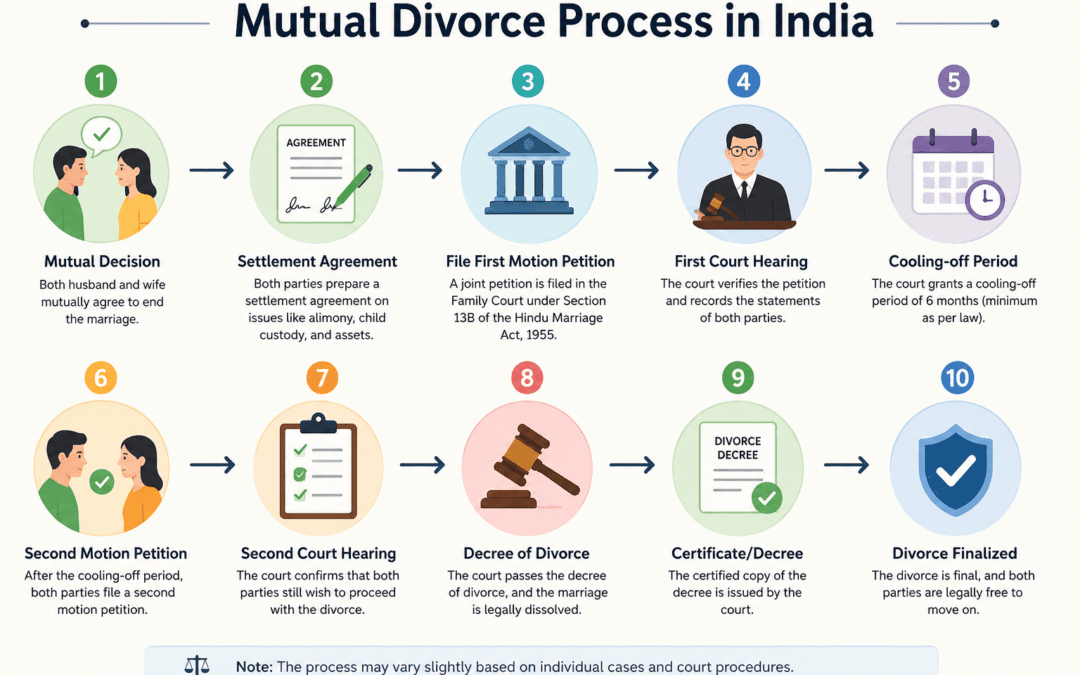
Step 1: Filing the Joint Petition (First Motion)
The parties file a joint petition in the Family Court of competent jurisdiction—typically where the marriage was registered, where the couple last resided together, or where the wife currently resides. The petition must be accompanied by an affidavit stating that the parties have lived separately for a minimum statutory period of one year (two years under the Indian Divorce Act for Christians) and cannot reconcile.
Step 2: Court Scrutiny and Statements
The Family Court reviews the petition and supporting documentation. Both spouses must appear in person (or via authorized video conferencing under special NRI guidelines) to record their formal statements under oath.
Step 3: The Mandatory Cooling-Off Period (The Six-Month Window)
Under Section 13B(2) of the HMA, the court institutes a mandatory six-month statutory waiting period (cooling-off period). This timeline is designed to offer a final opportunity for reconciliation.
Important Legal Precedent: Under the landmark Supreme Court ruling in Amardeep Singh v. Harveen Kaur (2017), this 6-month period can be waived via an interlocutory application if the marriage has irreversibly broken down and delayed proceedings would cause undue hardship.
Step 4: Filing the Second Motion and Final Decree
If reconciliation fails, the parties must move the Second Motion between 6 and 18 months from the date of the first petition. The court conducts a final hearing, confirms the voluntary nature of the consent, and passes a formal decree dissolving the marriage.
3. Contested Divorce: Grounds and Complex Procedural Stages
When one party refuses to consent, a contested divorce must be initiated based on specific, legally recognized grounds under Indian law.
Recognized Legal Grounds
Petitions are built upon strict statutory criteria, including:
● Cruelty: Mental or physical harm.
● Desertion: Continuous abandonment for at least two consecutive years.
● Adultery: Voluntary sexual intercourse outside of the marriage.
● Other Grounds: Conversion to another religion, incurable mental illness, or venereal disease.
The Litigation Workflow
Drafting and Filing the Petition: The aggrieved party (petitioner) files a comprehensive petition detailing specific instances matching the legal grounds.
Issuance of Summons: The court issues a formal notice to the responding party (respondent), requiring their appearance.
Written Statement (Response): The respondent must file a detailed defense within 30 to 90 days.
Mandatory Mediation and Counseling: Indian Family Courts prioritize structural mediation. The judge will direct both parties to a court-appointed counselor to explore settlement options.
Framing of Issues and Trial: If mediation fails, the court points out the specific matters of dispute. Both sides submit written affidavits, present witnesses, and undergo rigorous cross-examination.
Final Arguments and Judgment: Attorneys present final legal arguments citing precedence, after which the judge delivers a judgment and issues a divorce decree.
4. Comprehensive Timeline Matrix
The operational time frames for matrimonial litigation in India fluctuate heavily depending on court pendency and the cooperative behavior of litigants:
Divorce Type | Procedural Phase | Estimated Duration |
Mutual Consent | First Motion & Statement Recording | 1 - 2 Months |
Cooling-Off Period (Unless Waived by Court) | 6 Months | |
Second Motion to Final Decree | 1 - 3 Months | |
Contested Filing | Pleadings (Petition, Summons & Written Statement) | 3 - 6 Months |
Mandatory Mediation & Reconciliation Phase | 2 - 4 Months | |
Evidence, Trial & Cross-Examination | 12 - 24 Months | |
Final Arguments & Judgment | 3 - 6 Months |
5. Conclusion
While a mutual consent divorce can realistically conclude within 6 to 18 months (or faster if waived), a contested
divorce typically spans 2 to 5 years, subject to appeals in higher courts. Parties embarking on this legal transition
are highly encouraged to compile immaculate asset, financial, and marriage documentation to help navigate the
legal machinery with minimal systemic delay.

Child Custody and Visitation Rights in India: Procedures, Types, and Legal Frameworks
The dissolution of a marriage is a deeply taxing event, but its complexity intensifies when minor children are involved. In the Indian legal landscape, child custody disputes are characterized by a departure from strict proprietary or parental rights. Instead, the legal machinery functions on a single, uncompromising baseline: the emotional, physical, and developmental well-being of the minor.
This comprehensive guide unpacks the statutory structures, custodial typologies, and operational procedures governing child custody and visitation rights in India.
1. The Statutory Framework Governing Custody in India
India’s pluralistic legal framework means that child custody is mediated through personal religious laws, working in tandem with civil legislation:
● The Guardians and Wards Act, 1890 (GWA): The primary secular, civil law governing custody and guardianship applications across all religious communities in India.
● The Hindu Minority and Guardianship Act, 1956 (HMGA): Outlines specific rules for Hindu, Buddhist, Jain, and Sikh parents. For instance, Section 6(a) states that the custody of a minor under the age of five ordinarily resides with the mother.
● Muslim Personal Law: Dictates custodial rights under the concept of Hizanat (the right of the mother to custody of her young children—typically up to age 7 for boys and puberty for girls) unless the court finds her unfit.
● The Special Marriage Act, 1954: Section 38 empowers family courts to issue interim and permanent custody orders for children whose parents had a civil marriage.
2. The Supreme Doctrine: "Welfare of the Child"
Regardless of what personal laws dictate, the Supreme Court of India has established across numerous landmark rulings (such as Gaurav Nagpal v. Sumedha Nagpal) that personal laws are subordinate to the "Welfare of the Child" doctrine.
When an Indian Family Court evaluates which parent should be granted custody, it does not simply look at who has more money. The court evaluates a mosaic of factors:
┌────────────────────────────────────────┐
│ WELFARE OF THE CHILD (Core Metric) │
└───────────────────┬────────────────────┘
│
┌────────────────────────────┼────────────────────────────┐
▼ ▼ ▼
┌──────────────────┐ ┌──────────────────┐ ┌──────────────────┐
│ Ethical & Moral │ │ Educational & │ │ Child's Personal │
│ Environment │ │ Financial Stability│ │ Preference │
│ (Safe home life) │ │ (Schooling/Care) │ │ (Ages 9 and up) │
└──────────────────┘ └──────────────────┘ └──────────────────┘
● Ethical and Moral Environment: Will the child be exposed to an abusive or unstable domestic atmosphere?
● Educational and Financial Stability: Can the parent provide consistent schooling, healthcare, and basic nutrition? (Note: A father cannot deny custody to a mother simply because she is less financially affluent; the court can order the father to pay child maintenance to close this gap).
● The Child’s Personal Preference: Under the GWA, if a child is old enough to form an intelligent preference (typically 9 years of age or older), the judge will interview the child in the privacy of the judge's chambers to record their wish.
3. The Structural Types of Child Custody in India
Indian Family Courts generally award custody under four distinct legal operational structures:
A. Physical Custody
One parent is designated as the primary caregiver with whom the child resides on a daily basis. The other parent is granted structured visitation rights.
B. Joint Custody
Though the child physically resides primarily with one parent, both parents retain equal rights to make major decisions concerning the child’s life, such as choices regarding schooling, medical procedures, religious upbringing, and passport generation. This model is highly encouraged by modern family law experts to reduce parental alienation.
C. Legal Custody
This grants a parent the absolute right to make all long-term developmental decisions for the child, completely independent of who the child lives with physically.
D. Split Custody
An uncommon layout where, if there are multiple children, custody of one child is given to the father and the other to the mother. Courts generally avoid this to keep siblings together unless extraordinary circumstances demand it.
4. Structuring Visitation Rights: Balancing the Equation
Unless a parent is proven to be a direct physical or psychological threat to the child, Indian courts operate under the presumption that a child needs the active love and guidance of both parents. If physical custody goes to one parent, the non-custodial parent (frequently the father) is granted robust Visitation Rights.
Modern family court decrees outline highly granular visitation schedules to prevent future litigation:
● Alternate Weekend Access: Spending Saturday morning to Sunday evening with the non-custodial parent.
● Holiday and Vacation Splitting: Allocating half of summer, winter, and Diwali vacations to each parent sequentially.
● Important Days: Spending specific hours with the child on their birthday, Father's Day/Mother's Day, or religious festivals.
● Digital Visitation: Fixed times during weekdays for video calls or phone conversations.
5. Conclusion
A standard child custody litigation path in India can run parallel to divorce trials, spanning anywhere from 1 to 3 years before a final permanent custody decree is issued. However, parents can drastically cut down this painful timeline by drafting a comprehensive Child Custody Settlement Deed during a Mutual Consent Divorce. By resolving custody amicably outside a contested trial, parents protect their children from the psychological trauma of family court battles and establish a healthy co-parenting template for the future.
Navigating NRI Divorce in India: Legal Procedures, Validity, and Remote Processing
Matrimonial disputes involving Non-Resident Indians (NRIs) introduce complex layers of Private International Law, jurisdictional conflicts, and strict statutory requirements. When a marriage solemnized in India faces an irreversible breakdown overseas, couples frequently grapple with unique legal uncertainties: Can we divorce without flying back? Will an overseas court decree be legally recognized in India? This comprehensive guide addresses the core legal procedures, operational timelines, and statutory safeguards governing NRI divorce queries in India.
1. Jurisdictional Realities: Where Can an NRI File for Divorce?
An NRI couple married under Indian laws cannot simply choose any jurisdiction. To file a divorce petition within the Indian Family Court system, the case must fall under the jurisdictional criteria specified by personal laws (such as Section 19 of the Hindu Marriage Act, 1955 or Section 31 of the Special Marriage Act, 1954):
● The location where the marriage was originally solemnized.
● The location where the couple last resided together as husband and wife.
● The location where the wife is currently residing at the time of filing the petition.
● The location where the respondent (the defending party) resides at the time of the petition.
Even if both parties reside in countries like the United States, United Kingdom, or the UAE, Indian Family Courts retain concurrent jurisdiction if the marriage was registered under Indian law.
2. Remote Processing: Can an NRI Obtain a Divorce Without Travelling to India?
One of the most frequent logistical challenges for NRIs is the inability to travel to India for prolonged court hearings due to employment, visa restrictions, or financial constraints. Indian jurisprudence has evolved significantly to accommodate remote processing through two primary mechanisms:
A. Filing via a Special Power of Attorney (PoA)
If a couple decides to opt for a Mutual Consent Divorce (Section 13B of the HMA), they do not necessarily have to be physically present to present the initial petition.
The NRI spouse can execute a Special Power of Attorney in their country of residence.
The PoA document must be attested by the local Indian Embassy or Consulate, or apostilled in accordance with the Hague Convention.
Once sent to India, the designated family member or legal representative registers the PoA, enabling them to sign the pleadings and move the first motion on behalf of the NRI.
B. Virtual Court Appearances and Video Conferencing
Historically, both spouses had to stand before the Family Court judge to record statements for the First and Second Motions. Following landmark directives from the Supreme Court of India, Family Courts across states like Kerala, Punjab, and Delhi routinely allow NRIs to record their statements and undergo mediation via secure video conferencing links.
This technological integration can effectively reduce an NRI’s physical travel requirement to zero for mutual consent proceedings.
3. The Validity of Foreign Divorce Decrees in India
A common, high-stakes error made by expatriates is assuming that a divorce granted by a foreign court (e.g., a UK County Court or a US Family Court) is automatically binding in India. Under Section 13 of the Civil Procedure Code (CPC), 1908, a foreign judgment is not conclusive if it violates specific legal benchmarks.
To be recognized as valid in India, a foreign divorce decree must meet the following criteria established in the locus classicus ruling Y. Narasimha Rao v. Y. Venkata Lakshmi (1991):
Criteria for Validity | Legal Requirement & Meaning |
Competent Jurisdiction | The foreign court must have jurisdiction recognized by Indian law (e.g., the parties must have submitted to its jurisdiction voluntarily). |
Merits of the Case | The decree must be passed on the actual substantive grounds of the case, not just technical defaults. |
Principles of Natural Justice | The spouse remaining in India must have been properly served formal summons and given a fair opportunity to contest the case. |
No Fraud or Collusion | The decree must not have been obtained by misrepresenting facts or hiding active Indian court proceedings. |
The Danger of the "Ex-Parte" Foreign Decree
If an NRI husband files for a fast-track divorce in a foreign court and the wife residing in India does not actively participate or contest it, the foreign court may pass an Ex-Parte Decree. In the eyes of Indian law, such a decree is frequently deemed invalid and non-binding. Consequently, if the husband remarries based on that foreign decree, he faces criminal exposure for bigamy under Indian statutes.
4. Child Custody and International Parental Child Abduction
NRI matrimonial disputes often feature severe conflicts regarding the relocation of minor children. India is not a signatory to the Hague Convention on the Civil Aspects of International Child Abduction (1980).
Therefore, if a parent removes a child from a foreign country and brings them to India against a foreign court’s custody order, Indian courts do not automatically repatriate the child. Instead, Indian Family Courts initiate an independent review under the principle of the "Welfare of the Child", treating it as the supreme consideration over any foreign court decrees.
5. Conclusion
For an NRI, navigating a matrimonial split requires careful synchronization between domestic Indian laws and international court orders. While a mutual consent NRI divorce leveraging Power of Attorney and video conferencing can comfortably conclude within 6 to 8 months, contesting a multi-jurisdictional case or attempting to validate an unfavorable foreign decree can trigger civil litigation lasting 3 to 5 years. Securing early legal counsel in India before initiating foreign court filings remains the safest strategy to safeguard assets, child custody, and civil status.
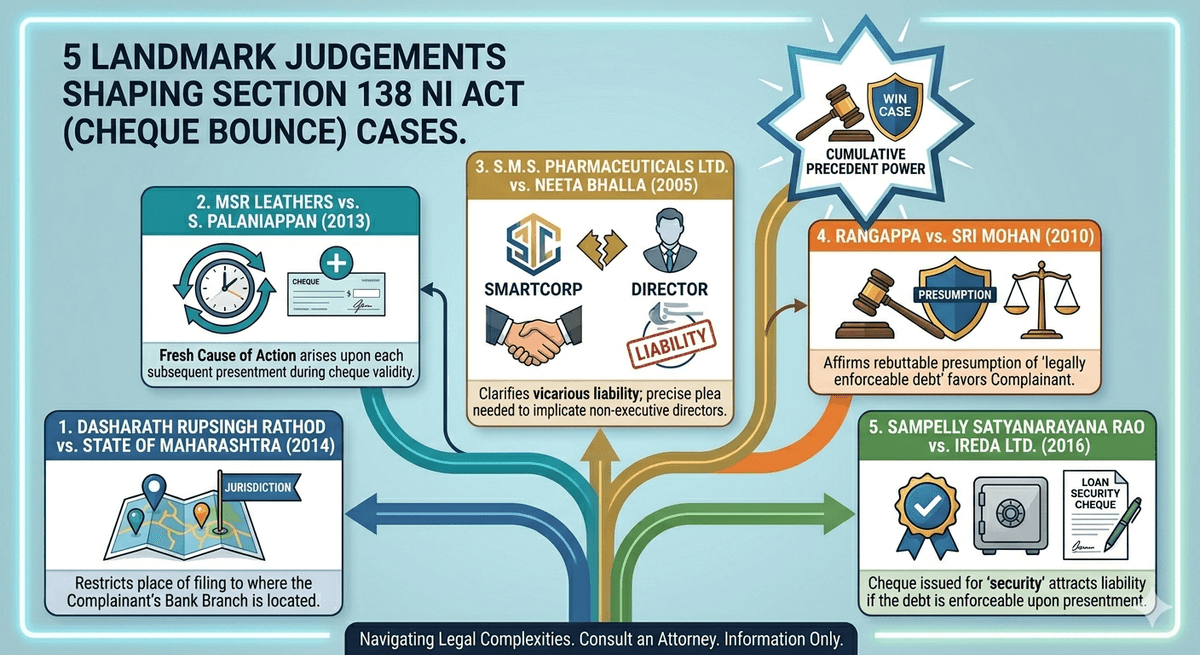
Deconstructing Cheque Bounce Law: 5 Landmark Judgments Defining Section 138
Section 138 of the Negotiable Instruments Act, 1881, is one of the most frequently invoked provisions in Indian courts. While the statute lays the groundwork for prosecuting cheque dishonor as a criminal offense, it is the judiciary that has shaped its practical application. Over decades, the Supreme Court of India has delivered several landmark judgments that have clarified complexities, resolved contradictions between different courts, and established concrete rules that apply today.
For any legal professional, business owner, or individual involved in a Section 138 case, understanding these specific precedents is not optional—it is essential for building a strategy.
Why Landmark Precedents Matter in NI Act Cases
The Negotiable Instruments Act is a complex piece of legislation. It aims to ensure credibility in business transactions by making cheque bounce a punishable offense. However, real-world scenarios—such as delayed notices, cheques issued for security, or jurisdictional disputes—often fall into gray areas.
Landmark judgments act as a binding guide (Stare Decisis) for lower courts. They provide the definitive interpretation of the law, making legal outcomes more predictable and ensuring uniformity across the country.
Here are five seminal judgments that have fundamentally altered the landscape of Section 138 litigation.
1. The Question of Jurisdiction: Dashrath Rupsingh Rathod vs. State of Maharashtra (2014)
Perhaps the most significant procedural shift in Section 138 history occurred with the Dashrath Rupsingh Rathod judgment.
The Precedent: Before this ruling, complainants often filed cases in jurisdictions that were convenient for them, sometimes far from where the accused resided, leading to significant harassment. The Supreme Court established a strict rule: the territorial jurisdiction for filing a Section 138 complaint lies only where the cheque is presented for payment (the complainant’s bank branch).
Impact: This judgment stopped "forum shopping" and brought uniformity. Although the Negotiable Instruments (Amendment) Act, 2015 later refined this rule slightly (affirming jurisdiction where the payee delivers the cheque for collection), the Dashrath Rathod decision remains the foundational precedent that defined the primary location for initiating a case.
2. The Finality of the 15-Day Notice: MSR Leathers vs. S. Palaniappan (2013)
Section 138 requires a payee to send a statutory notice within 30 days of the cheque bounce, giving the drawer 15 days to pay. If payment isn't made, the "cause of action" arises. But what if the cheque is presented again and bounces again?
The Precedent: In MSR Leathers, the Supreme Court overthrew an earlier precedent. It ruled that a payee can present a cheque multiple times within its validity period. A fresh cause of action arises each time the cheque bounces and a new statutory notice is sent.
Impact: This gave creditors a vital strategic tool. If they missed the deadline to file a complaint after the first notice, they could present the cheque again, send a fresh notice, and restart the clock, provided the cheque was still valid.
3. Vicarious Liability and Non-Executive Directors: S.M.S. Pharmaceuticals Ltd. vs. Neeta Bhalla (2005)
When a company issues a bounced cheque, Section 141 of the NI Act extends criminal liability to every person who was "in charge of, and was responsible to, the company for the conduct of the business."
The Precedent: In S.M.S. Pharmaceuticals, the Court clarified the extent of this "vicarious liability." Crucially, it ruled that not every director is automatically liable. A specific plea must be made in the complaint describing how a particular director was responsible for the company’s day-to-day operations and the specific transaction.
Impact: This ruling protected non-executive directors and sleeping partners from malicious prosecution, forcing complainants to prove specific active roles in the business before criminal liability could be attached.
4. The Presumption of Enforceable Debt: Rangappa vs. Sri Mohan (2010)
Section 139 of the NI Act includes a strong presumption that the holder of a cheque received it "for the discharge, in whole or in part, of any debt or other liability."
The Precedent: The Rangappa judgment firmly established that this presumption is mandatory, not discretionary. However, it also clarified that this is a rebuttable presumption. The accused does not need to prove their innocence beyond a reasonable doubt; they only need to raise a "probable defense" that shifts the burden back to the complainant.
Impact: This balanced the playing field. It ensured that complainants don't have to initially prove the underlying debt exists, speeding up trials, while still allowing the accused a fair chance to disprove the liability with strong, probable evidence.
5. Cheques Issued as 'Security': Sampelly Satyanarayana Rao vs. Indian Renewable Energy Development Agency Ltd. (2016)
A very common defense in Section 138 cases is that the bounced cheque was only given as "security" for a loan, not as immediate payment.
The Precedent: In Sampelly Satyanarayana Rao, the Court ruled that if a cheque is issued as security and the debt has already become dynamic and enforceable at the time the cheque is presented, the "security" argument is invalid. If the loan amount is due and payable, a post-dated "security cheque" still triggers Section 138 liability if it bounces.
Impact: This judgment significantly strengthened commercial transactions. It closed a major loophole often used to evade liability, confirming that a "security cheque" becomes an "enforceable debt payment" the moment the underlying loan default occurs.
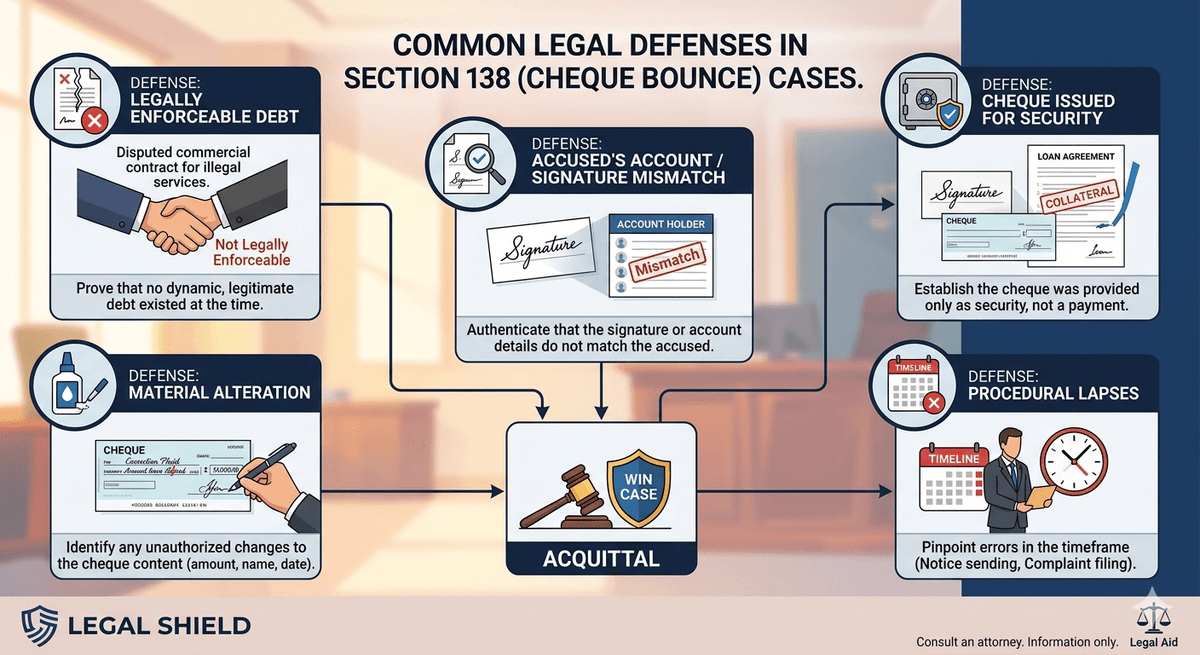
Strategic Legal Defenses in Section 138 Cheque Bounce Cases
Receiving a summons for a Section 138 complaint under the Negotiable Instruments Act is a serious legal matter that requires immediate and expert attention. While the law is often perceived as heavily favoring the complainant, the accused has access to several robust and specific legal defenses. A successful outcome often hinges on identifying the correct defense strategy early in the proceedings.
Here is an in-depth analysis of the common legal defenses typically used in Section 138 cases.
1. Disputing the Legally Enforceable Debt
The foundation of any Section 138 case is the existence of a legally enforceable debt. The law requires that the cheque must have been issued to discharge, in whole or in part, a liability or debt that is valid and recognized by law. If the underlying transaction is void, illegal, or non-existent, this defense can dismantle the entire prosecution.
Common Scenarios for This Defense:
● Time-Barred Debt: If the debt is legally unrecoverable due to the statute of limitations (usually three years), a cheque issued for its repayment might not attract Section 138 liability.
● Illegal Transactions: Cheques issued for gambling debts, dynamic contracts that are against public policy, or transactions involving prohibited goods cannot be enforced.
● No Initial Liability: Proving that the cheque was issued as an advance for a service that was never rendered or goods that were never delivered can invalidate the debt claim.
2. Signature Mismatch and Account Status
While technical, these defenses can strike at the validity of the negotiable instrument itself. Section 138 specifically covers dishonor due to "insufficient funds" or "exceeds arrangement." A dishonor for "Signature Differs" or "Account Closed" requires a careful look at the intent.
Strategy:
● Authentication of Signature: If the signature is genuinely not that of the accused, an expert opinion (handwriting analyst) can be vital.
● Intent: The defense can argue that there was no criminal mens rea (guilty mind) if the mismatch was accidental or if the account closure was unrelated to avoiding payment. The burden then shifts significantly to the complainant.
3. Material Alteration of the Cheque
Any unauthorized change to a cheque that alters its legal effect—such as changing the date, the payee’s name, or the amount—is considered a "material alteration" and renders the instrument void.
Key Evidence:
● Discrepancies: A defense lawyer will scrutinize the original cheque for overwriting, differing inks, or erase marks. If the amount in words and figures does not match (a technical error that is often fatal), or if the date has been altered to extend the validity of an old cheque, the accused may be acquitted.
4. Establishing that the Cheque Was Issued for Security Only
This is one of the most common and effective defenses. Cheques are often demanded as "security" for loans, rentals, or business agreements, intended to be encashed only upon specific breaches. They are not intended as immediate payment.
The Burden of Proof:
● Proving Intent: The accused must prove through documentation (like a written agreement or email chain) that the complainant was not authorized to present the cheque for encashment at that time. The central argument is that the cheque was not issued to discharge an existing liability, but rather as collateral.
● Pre-existing Liability: If the liability for the specific amount on the security cheque had not yet crystallized when it was presented, the case might fail.
5. Identifying Procedural and Technical Lapses
The Section 138 process is highly regimented with strict statutory timelines. A single procedural error by the complainant can prove fatal to the prosecution's entire case.
Key Timelines to Scrutinize:
● The 30-Day Limit: The dynamic legal notice must be sent within 30 days of the cheque return memo date.
● The 15-Day Limit: A criminal complaint cannot be filed until the 15-day notice period for the accused to pay has expired.
● Jurisdiction: The complaint must be filed in the correct court having geographic jurisdiction where the payee's bank branch is located (following the Dashrath Rupsingh Rathod v. State of Maharashtra judgment).
● Filing Deadline: The complaint itself must be filed within one month of the cause of action arising (i.e., after the 15-day notice period expires).
Conclusion
Navigating a Section 138 case is legally complex. While common defenses like "security cheque" or "procedural lapses" are frequently deployed, they must be tailored to the specific facts and evidence of each case. It is paramount to consult a specialized criminal defense lawyer as soon as a notice or summons is received to build a robust defense strategy from the outset.
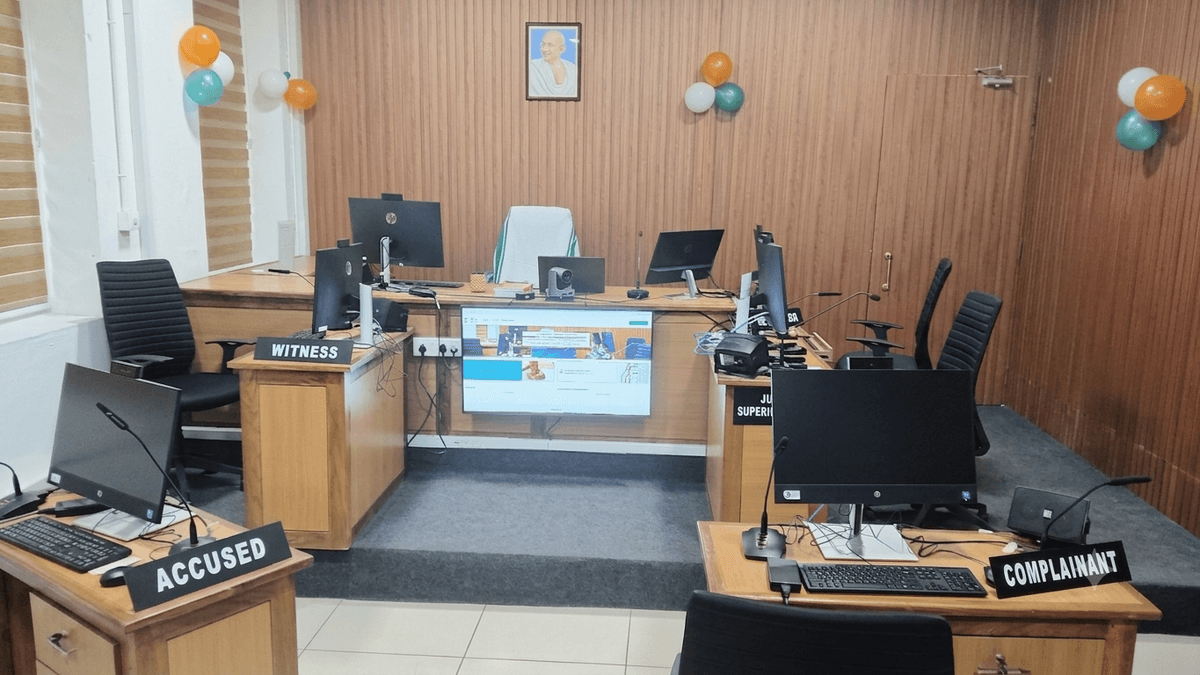
The Digital Evolution of Summary Trials: How Kerala’s 24x7 "ON Court" Portal is Revolutionizing Section 138 Litigation.
In the landscape of Indian jurisprudence, few issues clog the lower judiciary quite like Section 138 of the Negotiable Instruments (NI) Act. Cheque bounce cases make up over 10% of total criminal pendency nationwide, transforming a straightforward financial recovery mechanism into a long, drawn-out litigation nightmare.
However, a major shift began in late 2024 when the High Court of Kerala launched a pioneering solution: the 24x7 "ON Court" digital portal. First rolled out in the Kollam district, this Open and Networked (ON) platform is redefining summary trials. By replacing traditional, paperwork-heavy processes with a modern, asynchronous ecosystem, Kerala is demonstrating how Phase III of India's E-Courts Project can function in practice.
The Bottleneck: Why Section 138 Needed a Digital Overhaul
By law, a cheque bounce case is intended to be a summary trial—a streamlined legal track meant to resolve disputes quickly. Yet, a typical Section 138 sequence involves strict, unforgiving timelines that easily break down under manual management:
The cheque must be presented within its validity window.
A statutory demand notice must be issued within 30 days of receiving the bank's return memo.
The drawer receives a strict 15-day payment window upon receiving the notice.
If payment fails, a formal criminal complaint must be filed within the next 30 days.
In a traditional courtroom, keeping up with these tight windows means dealing with endless physical filings, manual error corrections, delays in sending physical summonses (RPAD), and frequent court visits just to get a signature or clear a technical checklist.
Enter Kerala's 24x7 "ON Court" Portal
The 24x7 ON Court portal converts this date-sensitive litigation track into an entirely automated digital workflow. Accessible anytime and from anywhere, the system offers an optimized experience for every person involved in the legal process.
1. For Litigants: Access and Transparency
The platform removes the need to constantly visit law offices just to sign papers or check dates.
● Real-Time SMS Alerts: Litigants receive proactive text messages updating them on the case's progress, due payments, or actions required.
● Unique Client Logins: Individuals can log in to view their entire case file, check amounts paid, track summons delivery status, and view court orders instantly.
2. For Advocates: Streamlined Digital Filing
Lawyers can handle cases smoothly without standard physical constraints:
● Digitally Native E-Filing: System-assisted rules check documentation requirements (such as matching the dishonored cheque, bank memo, legal notice, and postal tracking receipts) before submission, cutting down on early procedural errors.
● Integrated E-Payments: Court fees, stamps, and handling charges are paid entirely online through the platform.
3. For Judges and Court Staff: Smarter Workflow Management
The platform cuts through administrative backlogs:
● Asynchronous Scheduling & Virtual Hearings: Judges can review cases digitally, and lawyers or litigants can join live hearings via an integrated "Join Hearing" tool directly on the dashboard.
● Bulk Digital Signatures: Judges can use pre-defined templates to draft orders and sign them securely in bulk, removing common clerical delays.
● Automated Summons Tracking: Court staff no longer need to type out repetitive data. Summonses are auto-generated and tracked across multiple digital and physical channels seamlessly.
Why "ON Court" is a Game Changer for Legal SEO and the Public
As Kerala continues to lead the nation in digital literacy, online searches for terms like "how to track a cheque bounce case in Kerala," "Section 138 e-filing guidelines," and "Kollam 24x7 digital court" have scaled rapidly.
The ON Court portal directly addresses these user needs by hosting a clear Support and Video Tutorial hub right on its website. This helps both lawyers and everyday citizens understand the necessary documentation—from identity proofs to postal acknowledgments—needed to file a successful complaint or apply for system-generated bail bonds.
Conclusion: The Blueprint for Modern Indian Courts
The digital evolution of summary trials in Kerala is more than just a technological upgrade; it is a fundamental shift in how justice is delivered. By turning a traditionally slow prosecution track into a fast, transparent digital platform, the 24x7 ON Court portal shows how automation can ease the burden on our judiciary.
As this model expands beyond its initial police jurisdictions and districts, it offers a proven blueprint for the rest of India to resolve minor financial disputes efficiently, one digital file at a time.