Strategic Legal Defenses in Section 138 Cheque Bounce Cases
13 Jul 2026 · 5 min · Legal Team
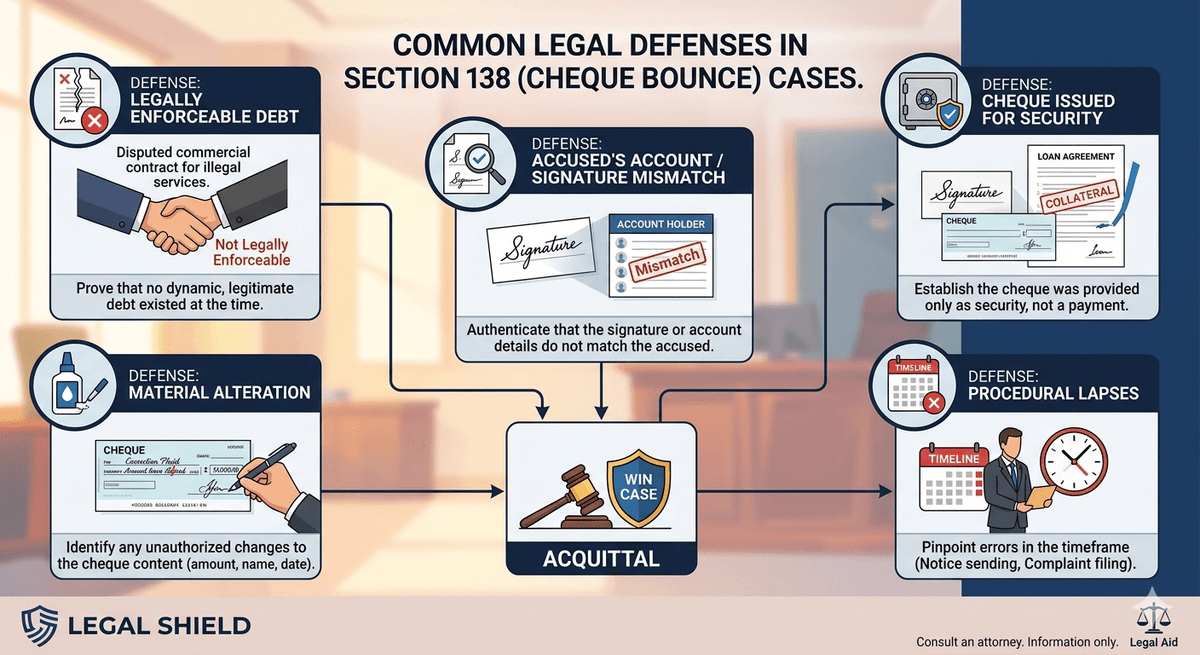
Receiving a summons for a Section 138 complaint under the Negotiable Instruments Act is a serious legal matter that requires immediate and expert attention. While the law is often perceived as heavily favoring the complainant, the accused has access to several robust and specific legal defenses. A successful outcome often hinges on identifying the correct defense strategy early in the proceedings.
Here is an in-depth analysis of the common legal defenses typically used in Section 138 cases.
1. Disputing the Legally Enforceable Debt
The foundation of any Section 138 case is the existence of a legally enforceable debt. The law requires that the cheque must have been issued to discharge, in whole or in part, a liability or debt that is valid and recognized by law. If the underlying transaction is void, illegal, or non-existent, this defense can dismantle the entire prosecution.
Common Scenarios for This Defense:
● Time-Barred Debt: If the debt is legally unrecoverable due to the statute of limitations (usually three years), a cheque issued for its repayment might not attract Section 138 liability.
● Illegal Transactions: Cheques issued for gambling debts, dynamic contracts that are against public policy, or transactions involving prohibited goods cannot be enforced.
● No Initial Liability: Proving that the cheque was issued as an advance for a service that was never rendered or goods that were never delivered can invalidate the debt claim.
2. Signature Mismatch and Account Status
While technical, these defenses can strike at the validity of the negotiable instrument itself. Section 138 specifically covers dishonor due to "insufficient funds" or "exceeds arrangement." A dishonor for "Signature Differs" or "Account Closed" requires a careful look at the intent.
Strategy:
● Authentication of Signature: If the signature is genuinely not that of the accused, an expert opinion (handwriting analyst) can be vital.
● Intent: The defense can argue that there was no criminal mens rea (guilty mind) if the mismatch was accidental or if the account closure was unrelated to avoiding payment. The burden then shifts significantly to the complainant.
3. Material Alteration of the Cheque
Any unauthorized change to a cheque that alters its legal effect—such as changing the date, the payee’s name, or the amount—is considered a "material alteration" and renders the instrument void.
Key Evidence:
● Discrepancies: A defense lawyer will scrutinize the original cheque for overwriting, differing inks, or erase marks. If the amount in words and figures does not match (a technical error that is often fatal), or if the date has been altered to extend the validity of an old cheque, the accused may be acquitted.
4. Establishing that the Cheque Was Issued for Security Only
This is one of the most common and effective defenses. Cheques are often demanded as "security" for loans, rentals, or business agreements, intended to be encashed only upon specific breaches. They are not intended as immediate payment.
The Burden of Proof:
● Proving Intent: The accused must prove through documentation (like a written agreement or email chain) that the complainant was not authorized to present the cheque for encashment at that time. The central argument is that the cheque was not issued to discharge an existing liability, but rather as collateral.
● Pre-existing Liability: If the liability for the specific amount on the security cheque had not yet crystallized when it was presented, the case might fail.
5. Identifying Procedural and Technical Lapses
The Section 138 process is highly regimented with strict statutory timelines. A single procedural error by the complainant can prove fatal to the prosecution's entire case.
Key Timelines to Scrutinize:
● The 30-Day Limit: The dynamic legal notice must be sent within 30 days of the cheque return memo date.
● The 15-Day Limit: A criminal complaint cannot be filed until the 15-day notice period for the accused to pay has expired.
● Jurisdiction: The complaint must be filed in the correct court having geographic jurisdiction where the payee's bank branch is located (following the Dashrath Rupsingh Rathod v. State of Maharashtra judgment).
● Filing Deadline: The complaint itself must be filed within one month of the cause of action arising (i.e., after the 15-day notice period expires).
Conclusion
Navigating a Section 138 case is legally complex. While common defenses like "security cheque" or "procedural lapses" are frequently deployed, they must be tailored to the specific facts and evidence of each case. It is paramount to consult a specialized criminal defense lawyer as soon as a notice or summons is received to build a robust defense strategy from the outset.
Overview
Understanding your legal rights is the first step toward resolution. This guide is structured for readability, SEO performance, and long session engagement.
Legal Framework
Indian law provides specific remedies and procedures. Consult a verified lawyer for case-specific advice.
FAQ
When should I consult a lawyer? Early consultation often improves outcomes significantly.